
Prevent a scientific and societal disaster.
Protect independent science. Submit a comment by July 13.
The OMB rule would put political appointees over every federal grant and demote peer review to advisory. The public comment window closes by July 13. Here is how to file one that counts, and a writing party to do it together.
The writing partyTonight, Monday, July 13
This is the last night. Comments close at 8:59 p.m. Pacific tonight, which is 11:59 p.m. Eastern, so we write from 5 to 7 and you file before you go to bed. Bring your laptop. Think of one or two moments from your own work where this rule, if it took effect, would set your research back in a real and lasting way: a project that could be cancelled mid-stream, a record that would break if paused, a collaboration that would not survive the uncertainty. That concrete example is what makes a comment land. We will walk through the steps together, and you can file on the spot. SIO staff, graduate students, and postdocs are especially welcome.
Hosted by Taryn Black, Stephen Diggs, Nan Renner, Helen Fricker, and Jamin Greenbaum.
Before you fileSteps, and Liz Ginexi’s walkthrough
We will follow a step-by-step guide for filing on regulations.gov, so nobody gets stuck on the mechanics. If you would rather read ahead, Dr. Liz Ginexi, who spent 22 years as a scientific program official at the NIH, has written the clearest plain-language account of the rule available.
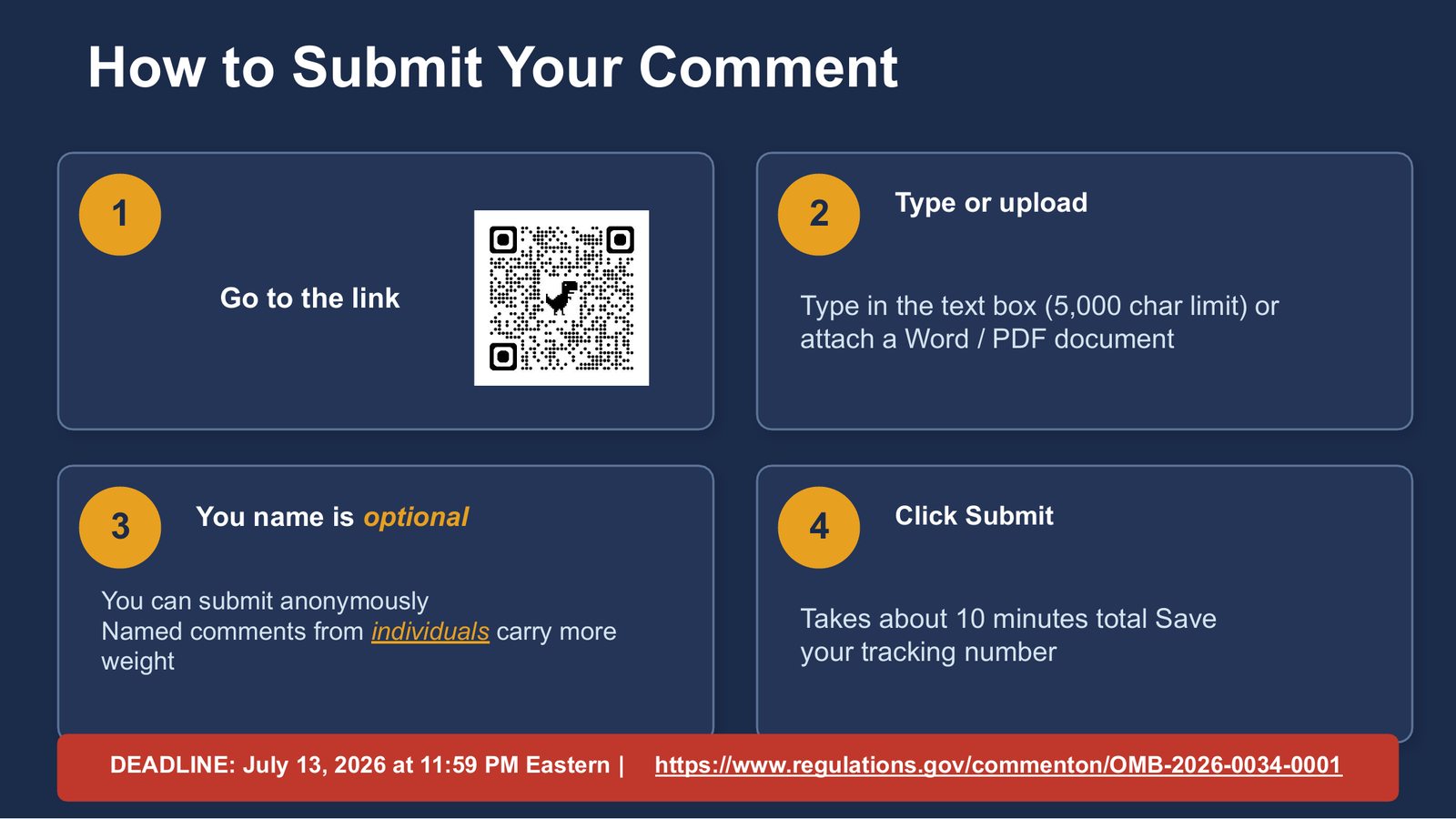
- Step-by-step: how to file your comment. The guide we will work from tonight.
- Her slides from the July 8 SIO session. The deck she presented, including the filing walkthrough above.
- Summary of key changes in the proposed rule. Ginexi’s section-by-section overview.
- Her own public comment, offered as a worked example rather than a template to copy.
- Her written testimony to the House Oversight Committee, June 30, 2026.
- Her running coverage of the rule.
Dr. Ginexi joined our July 8 writing party by Zoom and spent an hour answering questions from the SIO crew. These are the materials she pointed people to.
How to get thereFinding the Old Director’s House
Wind down La Jolla Shores Drive and turn at Naga Way. It is a sharp turn, so watch for the Scripps sign. The Old Director’s House is the two-story redwood house on Naga Lane, marked T-16, with the Ploughman sculpture nearby.
Why this mattersThe institution can file once. You can file too.
An institutional response is already underway, and it needs your individual voice next to it.
Under the Administrative Procedure Act, OMB has to read and respond to every substantive comment, and a high volume of them builds the record that supports a congressional stay and any later challenge. Even if OMB does not change course, that record is not wasted: the comments become the evidence base for the legal challenges likely to follow, and the courts may be where this is ultimately decided. The rule would put senior political appointees over every discretionary grant, make peer review advisory, allow active awards to be cancelled for shifting priorities, and restrict publication, conferences, and international collaboration. It binds every federal science agency on October 1, 2026. A flooded, substantive docket is the highest-leverage, lowest-risk thing almost anyone can do, and it closes in weeks.
Want the full case before you write? The briefing lays it out with sources and a floor statement for your representative, and the op-ed is a shorter version to share.
How to write one that countsFour moves, and one rule about your name
- Pick a provision and name it. Cite the section number, for example §200.205. A short reference list is below to help you choose.
- Say what it does to real work. Use a concrete example from your own research or program. Specifics carry far more weight than generalities.
- Propose an alternative if you can. What would work better, and why. Reviewers read for fixes, not just objections.
- Keep it yours. Do not copy and paste shared text. Identical comments are counted once, so personalize every submission.
Your comment does not need to be long, formal, or polished. A clear letter about one concrete harm carries real weight, and comments can come from anyone, not only organizations.
After you fileShare your comment
Filed one, or have a draft? Drop a copy in the shared Drive so we can watch the volume build and learn from each other's examples.
Your representativesFind your representatives
Beyond the public comment, your elected representatives are another point of contact on this rule. This section helps you find out who represents you and how to reach their offices. What you do with that information is up to you, and any message you send is your own, as an individual constituent.
Some background. A public comment asks OMB to reconsider its own rule. Congress can also act, by adding language to the spending bills that fund the government. Constituents writing about docket OMB-2026-0034 have been asking their members for that blocking language and telling OMB the changes to the federal grant rules (2 C.F.R. Part 200) are unacceptable.
How to find them. Find your U.S. Representative at house.gov and your two U.S. Senators at senate.gov. The U.S. Capitol switchboard is (202) 224-3121.
Filing a public comment is tied to the July 13 deadline. Reaching out to Congress is separate and not tied to that date.
ResourcesEverything in one place
The rule, and how to file
- The proposed rule in the Federal RegisterDocket OMB-2026-0034
- File your comment on regulations.govDocket OMB-2026-0034 · closes by July 13
Summaries and guidance
- Summary of key changes in the OMB ruleElizabeth Ginexi, former NIH program official
- What we need to do nextElizabeth Ginexi
- When science answers to politicsThe Planetary Society, plain-language overview
- Lawmakers warn proposed NOAA cuts would gut researchAIP FYI
- Stand Up for ScienceNational campaign and comment guidance
- Notes from the June 2 OMB follow-up meetingSteve Diggs
AGU
- Take action on the OMB ruleAGU action page
Examples and templates
Worked comments, a guide to writing one that counts, and shared templates now live on the Examples page.
Stay coordinatedWant to help organize?
Reach out to Helen Fricker, Nan Renner, or Steve Diggs. The community also coordinates through an encrypted SIO Signal group; contact Helen to join. The more of us who file something substantive before July 13, the louder the record.